Why you should (almost) never hangboard or do pull ups at body weight
Your body weight is (very likely) a terrible place to start for hangboarding and pull-ups.
Yeah, I said it.
The reason we tend to do hangboarding or pull ups (or push ups) with just our body weight is because it’s convenient. Just walk up and get a good workout in.
But is body weight the right resistance/intensity for those particular exercises at that particular time in your training cycle?
Veeeery likely not.
It’s arbitrary as hell.
And if you’re basing your training around it, you’re probably either:
Underdosing your exercises and spinning your wheels
Or overloading your tissues and flirting with injury
Let’s fix that. At Rock Rehab, we don’t mess around with exercise dosing. We dial that shit in!
The Real Problem: You’re Not Dosing Your Training
If you take one thing from this article, make it this:
Strength training is about dosage, not convenience.
Every effective strength program—whether it’s for powerlifting, rehab, or hangboarding—comes down to applying the right amount of load to create adaptation without breaking the system.
That load needs to be:
Specific enough to target the tissue
Heavy enough to stimulate adaptation
Controlled enough to avoid overload
Your body weight? It doesn’t check any of those boxes automatically.
It’s just… your mass.
Why bodyweight is a bad starting point
We’re going to talk about hangboarding for a minute here, but the EXACT same principles apply to pull ups, push ups, or any body weight exercise.
Let’s say you’ve never hangboarded before.
You walk up to the board, grab a 20mm edge, lift your feet, and hang your full body weight.
Cool. What just happened?
You didn’t “start training.”
You guessed.
And there’s a good chance you guessed wrong.
Scenario 1: You’re Too Weak for It
If your finger strength isn’t developed yet, full bodyweight hanging might put you at:
95–100% of your max effort
Or worse… beyond your current capacity
That’s not training. That’s a max test, every rep.
And max testing repeatedly leads to:
Tendon irritation that lingers for weeks
This is how people end up googling “Do I have an A2 pulley injury?” at 11pm.
Scenario 2: You’re Too Strong for It
Now flip it.
Let’s say you’ve been climbing for years. You’ve got solid finger strength.
You hop on the hangboard and hang bodyweight.
Congrats—you might be working at like… 50% of your max.
That’s not enough stimulus to drive meaningful adaptation.
You’re just… hanging out. Literally.
No progressive overload = no real strength gains. You gotta get those #gainz bro!
How about some examples
Sam is newer to climbing and wants to amp up his finger strength so he tests his 1-rep maximum of a half crimp on a 20mm edge.
Sam’s body weight is 150 lbs.
His half crimp 1 rep max is 150 lbs.
If he starts his program at his body weight, he’ll be working at 100% of his 1 rep max.
Pulley injury in t-minus 3, 2….
C’mon bro
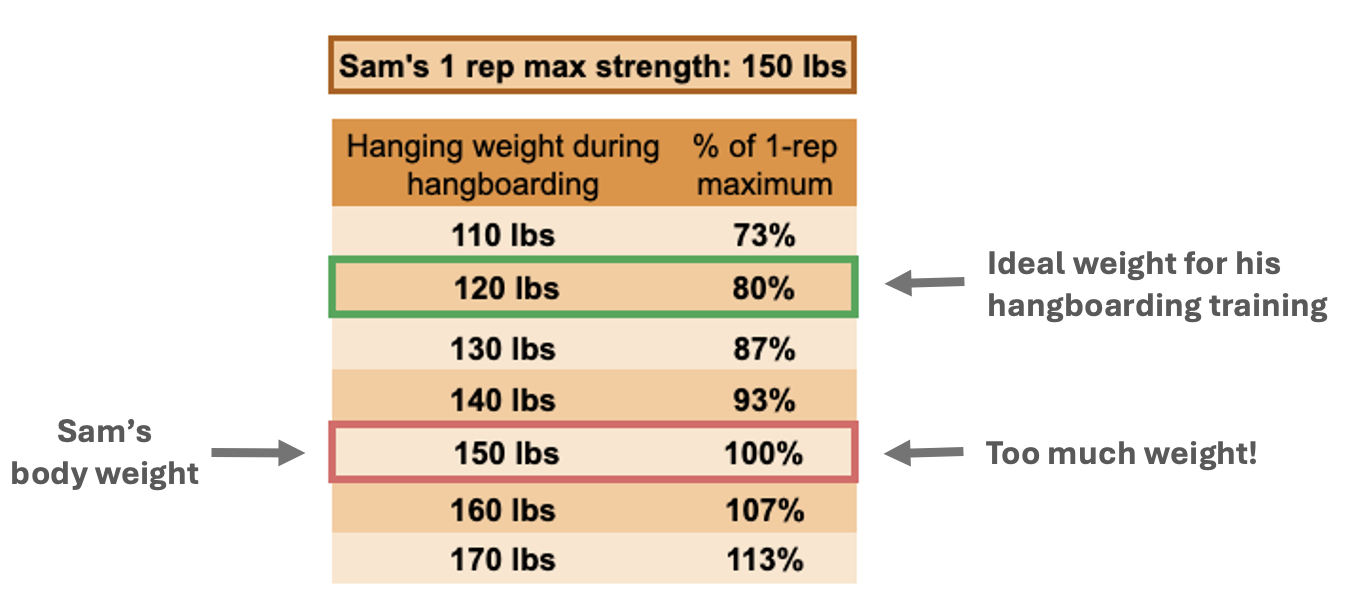
A more ideal weight to start with is 80% of his 1-rep max which would be 120 lbs. So he offloads 30 lbs from his body weight to achieve 120 lbs.
Now let’s look at Sam’s training over a 12 week period.
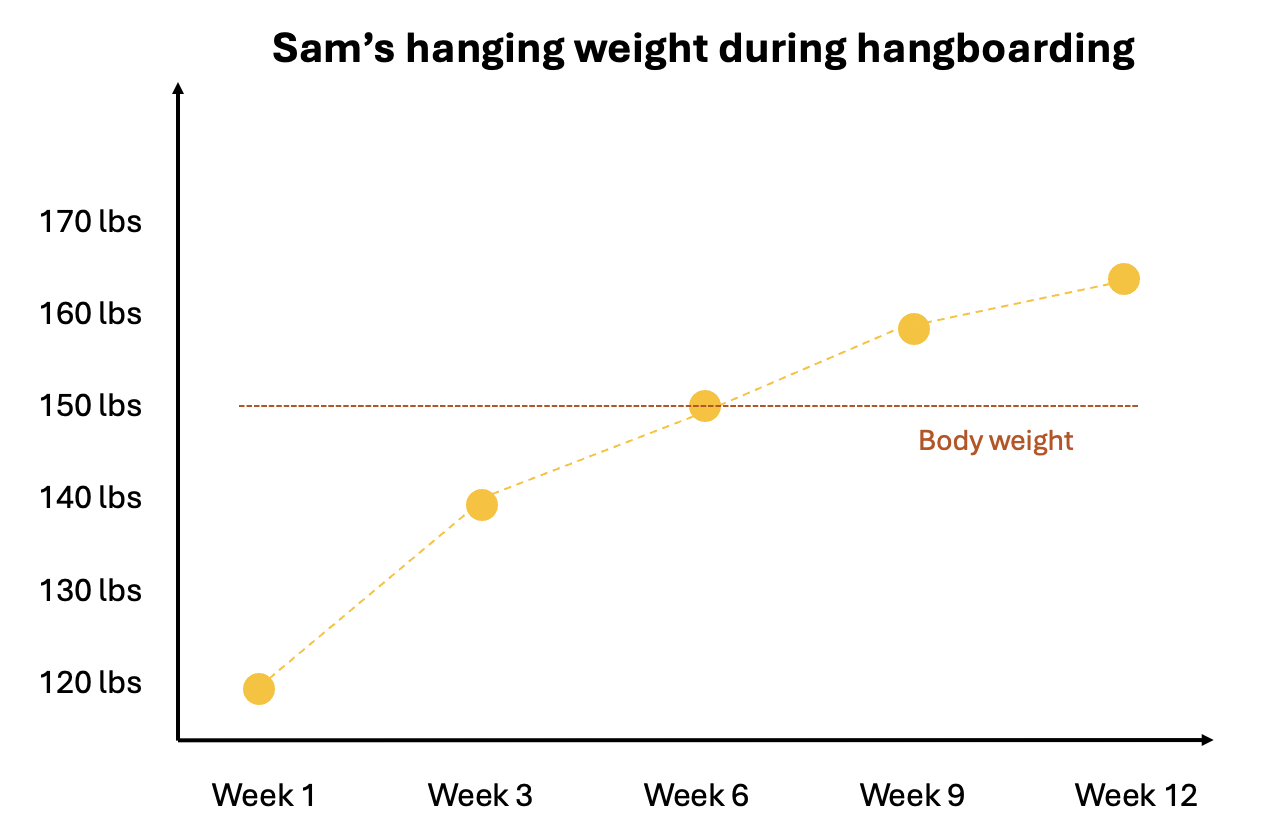
As he progresses over many weeks, you can see that he is hanging with his body weight at the 6 week mark.
But that’s just one step along the way. The very next week he is adding weight and blows right past his body weight.
When he started, his body weight was too heavy. Now his body weight is too light.
Way to go, Sam!
Example 2:
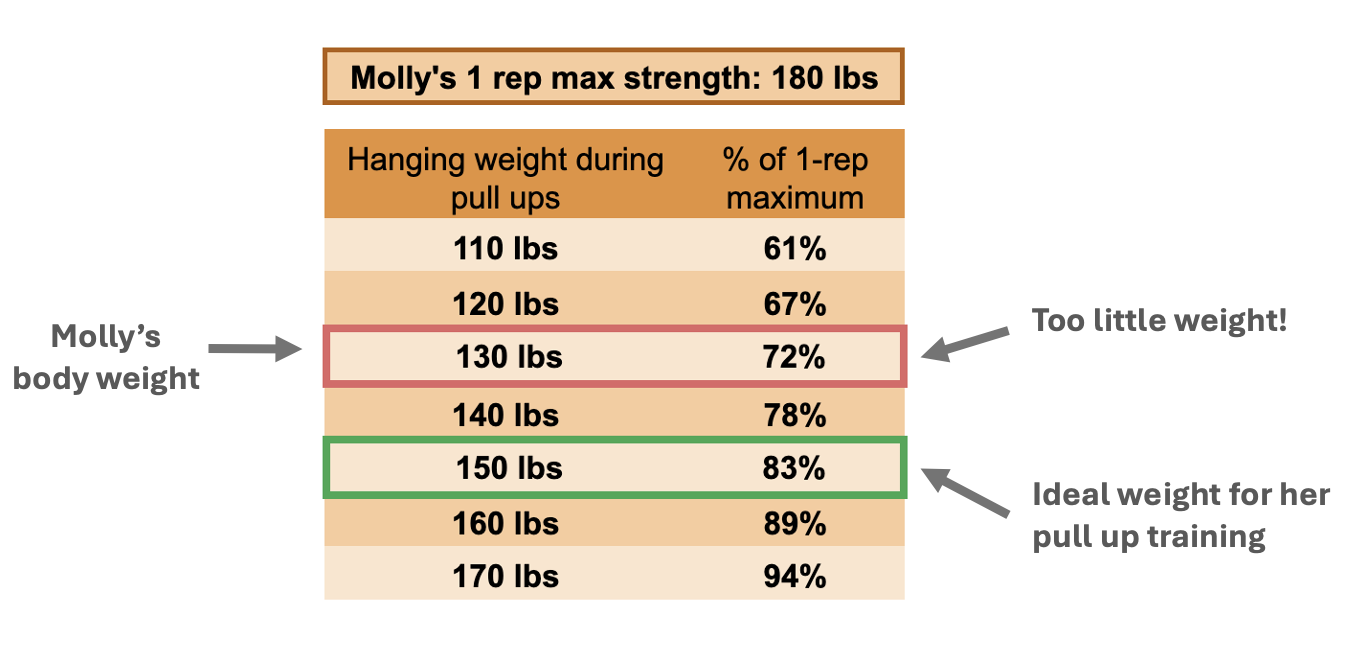
Molly is a crusher who’s working on her pull up strength.
Her body weight is 130 lbs.
Her pull up 1-rep max is 180 lbs.
If she does pull ups at 80% of her max, she will be pulling 150 lbs.
Body weight is too light!
As she progresses over 12 weeks, she is now pulling 190 lbs. That’s 60 lbs over her body weight!
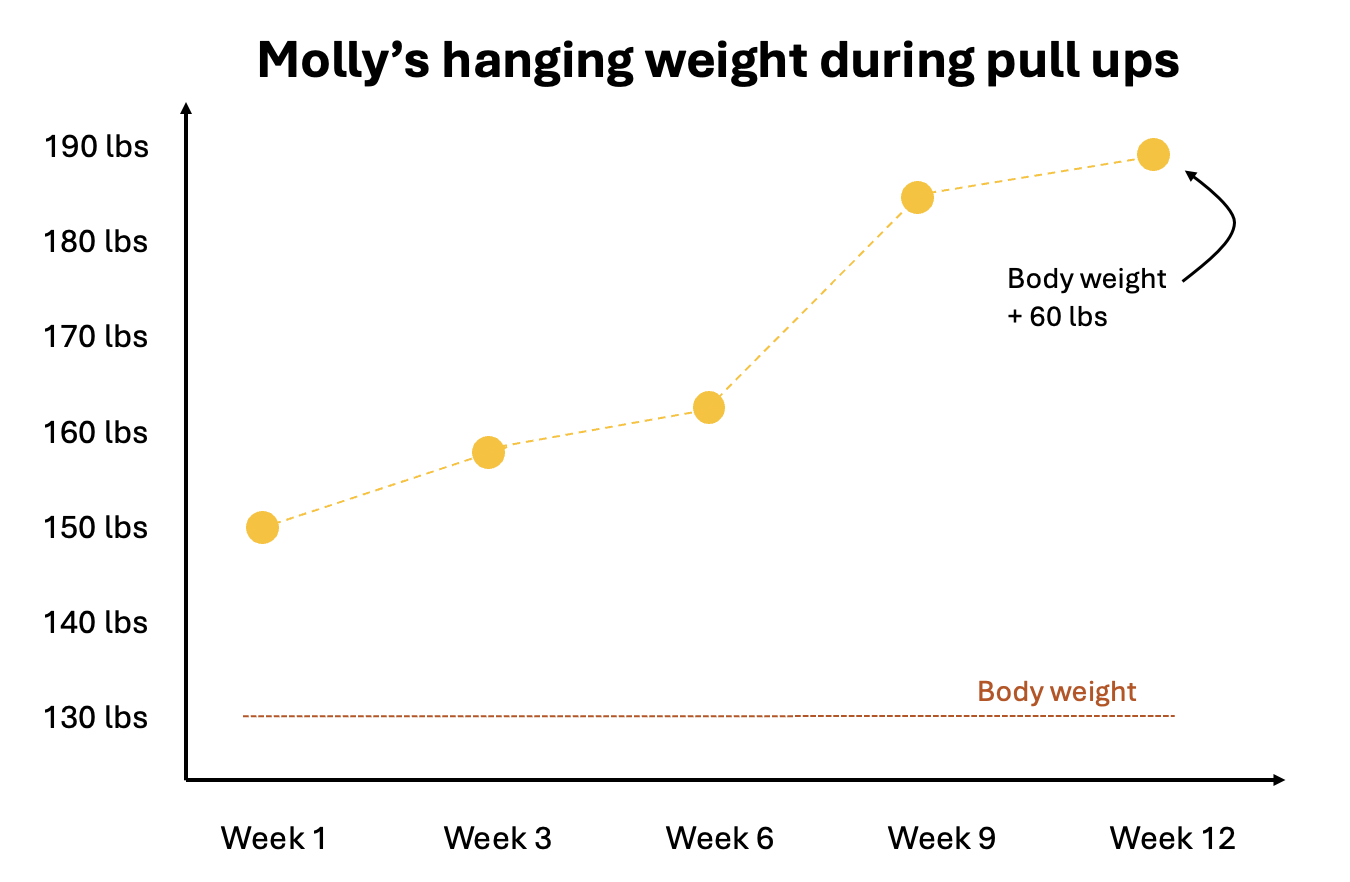
Doing pull ups with just her body weight would be significantly too light and would hold her back from her #gainz
So What Should You Do Instead?
You scale the load like an adult.
Your goal is to find a resistance that puts you in the right intensity zone, not some arbitrary number tied to the number on the bathroom scale.
The Sweet Spot: 70–85% Effort
For most strength adaptations (especially tendons), you want to be working in a zone that feels like:
Challenging
Repeatable
Controlled
Think:
You can hold the position for the prescribed time
You’re working hard, but not shaking like a leaf
You could maybe do 1–2 more seconds if you had to
You’re working at 7/10 or 8/10 “rating of perceived exertion”
That’s your zone
And guess what?
That zone will look different for everyone and will look different for you depending on how strong your fingers currently are.
Hangboarding: How to Actually Dose It
If you’re new to hangboarding, here’s your move:
Step 1: Assume Bodyweight is Too Heavy
Instead of jumping straight to full hangs:
Keep your feet on the ground
Or use a pulley system to offload weight
This lets you dial in the exact intensity.
Step 2: Find Your Working Load
You want a setup where:
You can hang for ~10 seconds
It feels hard but controlled
You’re not hitting failure every rep
If you can’t last 10 seconds → too heavy
If you could chill for 20+ seconds → too easy
Adjust accordingly.
You can also determine your 1-rep maximum and hang/pull at 70-85% of that number (a little more straight forward but a little higher risk of injury).
Step 3: Progress Intelligently
As your fingers adapt:
Gradually reduce assistance
Eventually reach bodyweight
Then go beyond it with added weight
That’s right, bodyweight isn’t the goal. It’s just a checkpoint.
At some point, bodyweight becomes underdosing.
Pull-Ups: Same Problem, Same Fix
Climbers do the exact same nonsense with pull-ups.
“I can’t do a pull-up yet, so I guess I just… try harder?”
Or:
“I can do 15 pull-ups, so I guess I’m strong?”
Neither tells you anything useful.
If You Can’t Do a Pull-Up Yet
Full bodyweight is definitely too much.
No bid deal. Just scale it:
Use a power band for assistance
Use an assisted pull up machine
Do negative pull ups only
Your goal is to hit a rep range of:
~ 5–8 reps for 3-4 sets
With good control
Without turning into a flailing mess
That’s how you build strength.
Not by grinding out one ugly rep every few days.
If You Can Do a Ton of Pull-Ups
If you’re cranking out 12–15 reps, guess what?
You should be working harder.
Time to:
Bust out that harness and strap some weights to it.
Slow down tempo or add a hold with your elbows at 90
Again, the goal is to land in that challenging-but-repeatable zone.
The Big Idea: Load Should Match the Athlete
Here’s the mindset shift:
Exercises don’t have fixed difficulty.
A hang on a 20mm edge is not “hard” or “easy.”
A pull-up is not inherently “advanced.”
They’re just movements.
The difficulty depends entirely on:
Your current strength
Your tissue capacity
Your training history
Which means the load needs to be customized to you.
Why This Matters (Especially for Climbers)
Climbers love to skip steps.
You see someone hangboarding bodyweight, so you do it too.
You see weighted pull-ups, so you jump there early.
But tendons don’t care about your ego. They adapt slowly.
And if you overshoot the correct dosage:
You don’t get stronger faster
You just get hurt sooner
A Better Way to Think About Training
Instead of asking:
“Can I do this at bodyweight?”
Ask:
“Is this the right intensity to drive adaptation right now?”
That question will:
Keep you progressing
Keep your tissues happy
Keep you climbing instead of rehabbing
Quick Reality Check
If you’re currently:
Failing hangboard sets regularly
Getting finger soreness that lingers
Plateauing on pull-ups
Or feeling like your training “isn’t doing much”
There’s a good chance your dosage is off.
Not your motivation. Not your genetics. Your dosage.
Final Takeaway
Your body weight is not a training program. It’s just a number.
Sometimes it’s too heavy. Sometimes it’s too light.
And on a very rare occasion, it is exactly right.
The climbers who actually get strong are the ones who:
Adjust load intelligently
Progress gradually
And train like they’re solving a problem—not proving a point
If you want help dialing in your hangboarding or pull-up program so you’re not just guessing and hoping your fingers survive…
You know where to find us: Rock Rehab
We’ll get you strong without wrecking your hands in the process. Also has anyone checked your form recently? We know someone who could. ;)
About the author:
Evan Ingerson is a physical therapist based in Santa Fe, NM, with over 25 years of climbing experience and 9 years specializing in treating climbers. He combines clinical expertise with firsthand knowledge of the sport to help climbers recover from injuries, build resilience, and perform at their best. Whether you’re nursing a finger tweak or rebuilding after surgery, Evan creates rehab plans that are as specific and strategic as your climbing goals. Outside the clinic, you’ll find him on the rock, testing his own advice one route at a time.